Payroll Cultures
The payroll culture contains settings for the date, currency and number format. Part of the culture is also the system calendar, which is the basis for the Payroll Calendar.
Culture Objects
The Payroll Engine defines the culture for data entry, the payrun and data output.
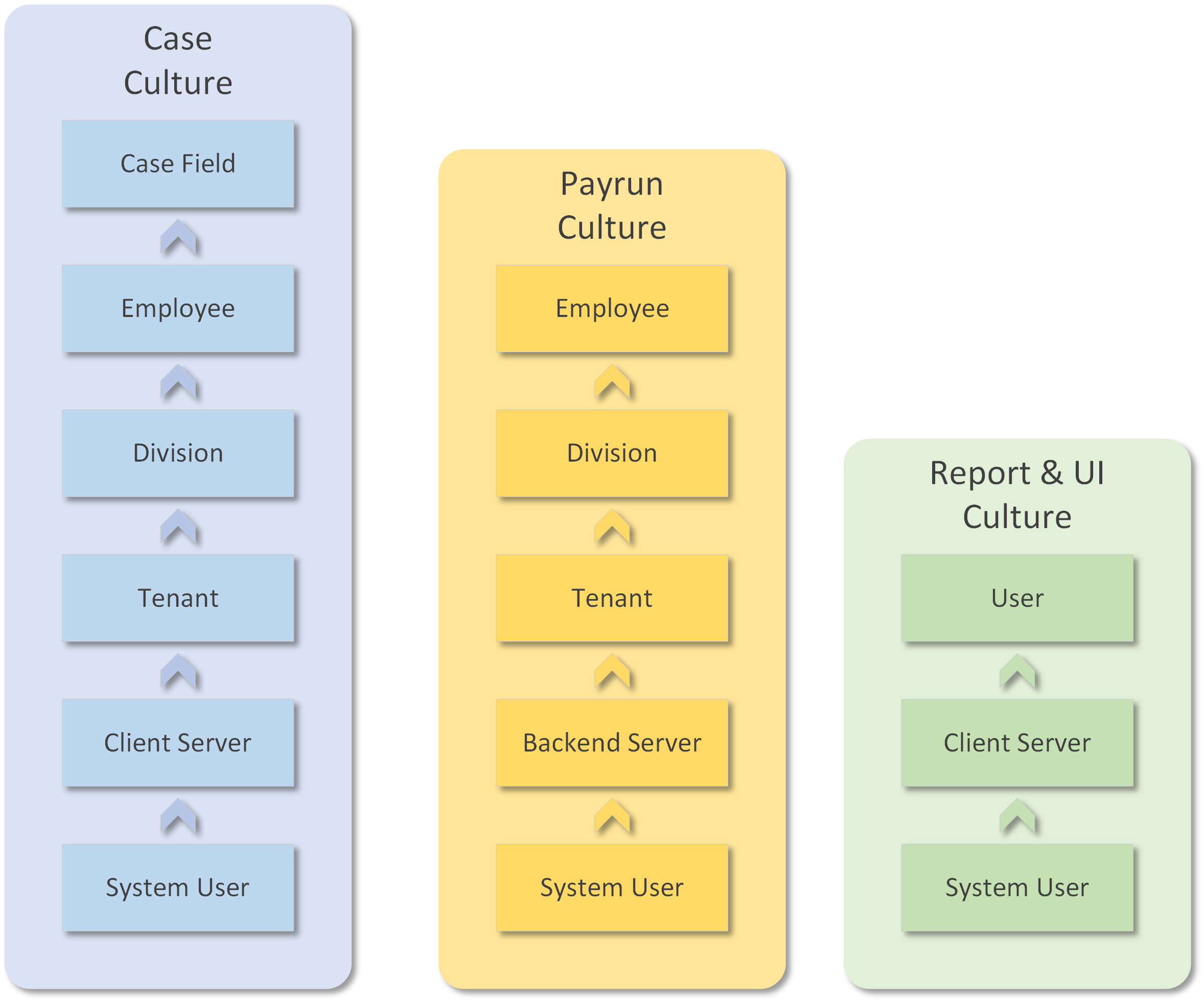
The culture is selected according to a top-down approach, which offers the possibility to influence the culture at different levels.
The culture for the backend server, the Payroll Console and the web application is set in the application configuration
app.config.
Culture Code
The format for the payroll culture name based on RFC 4646 is languagecode2-country/regioncode2, where languagecode2 is the two-letter language code and country/regioncode2 is the two-letter subculture code.
Examples include
ja-JPfor Japanese (Japan) anden-USfor English (United States). In cases where a two-letter language code is not available, a three-letter code as defined in ISO 639-3 is used.
Input Value Culture
The input culture during data entry is determined by the following order. 1. Case field 2. Employee 3. Division 4. Tenant
If an employee receives their salary in multiple currencies, the department to which they are assigned determines the culture.
If a value differs from the base currency, the culture is determined by the one assigned in the Case Field field.
Output Value Culture
The date and number formats used to calculate wage data are determined by the following criteria. 1. Wage Type and Collector 2. Employee 3. Division 4. Tenant
The Wage Type and Collector cultures are used to calculate individual currency values.
User Interface Culture
The visible identifiers of the payroll objects can be translated for each culture. In the localizations, the localised text is recorded for the culture code.
wageTypes:
- wageTypeNumber: 100
  name: Salary
  nameLocalizations:
    en: Salary       # language only
    de: Gehalt
    de-CH: Lohn      # language + region (overrides de for Switzerland)
    es: Salario
    zh-CN: 薪资
Web Application Localization
The user interface of the web application is currently available in the following languages
- English
- German
The user's culture controls the language of the user interface in the web application.
Further translation contributions are welcome.